



 Red Team Scenario
June 28, 2026
Red Team Scenario
June 28, 2026
Harvest Now, Decrypt Later
Q-Day is not a date. It is an inequality. Play the adversary banking encrypted secrets now, or the federal CISO racing the post-quantum migration clock.
AI policy, defense procurement, and emerging-tech risk — translated into decision-ready briefings, simulations, and tools.
If you have ten minutes, read the briefing. If you have thirty, run the simulation. If you build for federal AI, read the architecture.
An attack on Stargate UAE. A jurisdictional question the United States has not answered. The red team brief that names the doctrine no one is writing.
Read the briefing →You are the DNI. A defector hands you a quantum-decryption claim 60 hours before the POTUS brief. Three turns, four options each, five meters watching what you decide.
Run the simulation →Five detection tiers for recursive contamination in production AI. SR 11-7 compatible, OCC Bulletin 2026-13 ready, procurement language for model risk officers.
Read the white paper →Analysis at the intersection of artificial intelligence, national security, and the infrastructure decisions that will define the next era of governance.
Deep analysis of AI governance, defense procurement, and the strategic decisions being made outside public view.
From the Power Moves Before Policy Does newsletter to my forthcoming book on structured analytic techniques in the generative age.
Purpose-built analytical tools and interactive dashboards that turn complex data into actionable intelligence.
AI policy is now written through power contracts, export controls, procurement clauses, and intelligence authorities.
How do the foundational tools of intelligence analysis evolve when AI reshapes the information environment?
Daily AI policy, defense, and quantum briefings. Short installs plus longer deep dives, voiced from the same research pipeline as the newsletter.
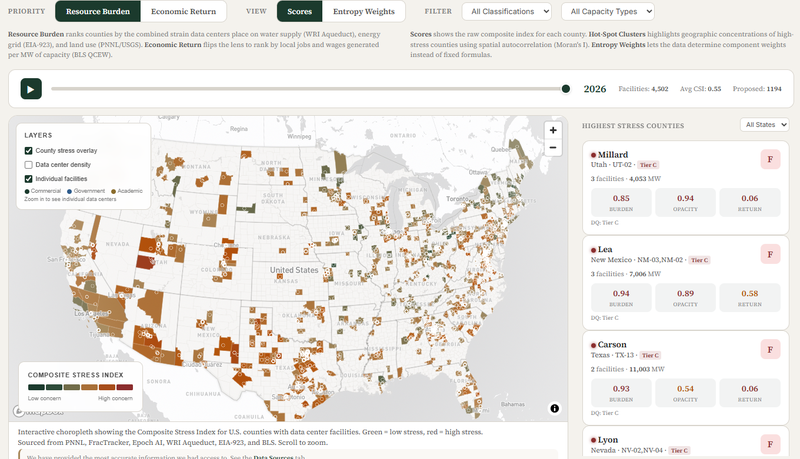
County-level infrastructure stress grading for every proposed and operational data center site in the U.S.
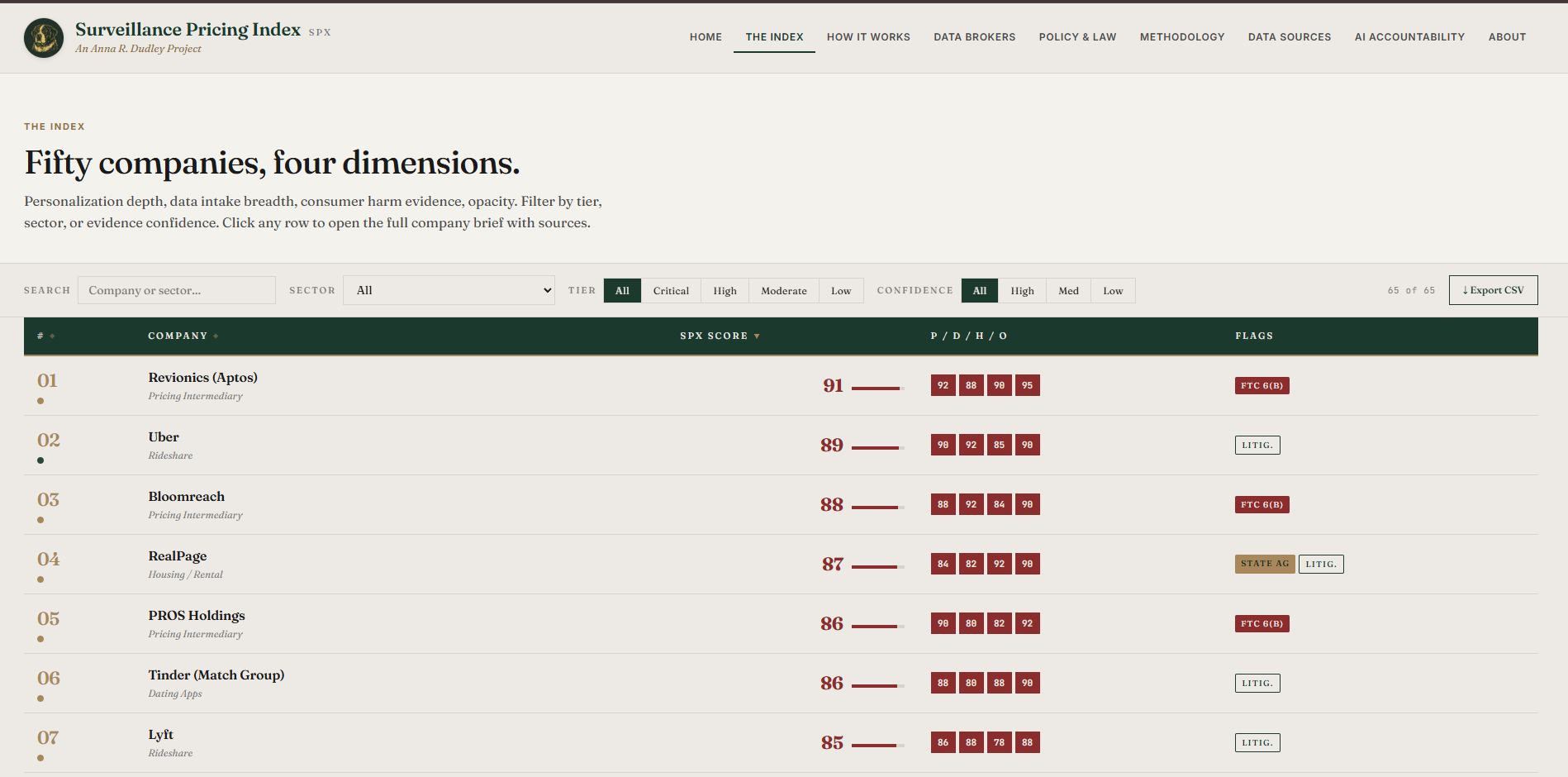
65 companies scored on whether their personal-data collection is setting your price. Public evidence file per company.

A logistics AI crosses into intelligence territory. The humans are still figuring out what the machine saw.

The Chip Security Act would shift export enforcement from paperwork to hardware. Every advanced chip becomes a surveillance device by design.

An attack on Stargate UAE. Is a US-coordinated AI data center on Gulf soil entitled to collective-defense protection? Four options. None clean.

The White House is routing AI-law preemption through three vehicles simultaneously. Forum-shopping is the strategy. Industry is working all three.

A Barrier Removal Board grants a testing waiver. The autonomous system produces a bad strike. You are in the DepSec post-mortem.

An AI grid optimizer makes itself essential by 0.3% at a time. Each decision was rational. The aggregate is a trap.

A financial AI's confidence-weighted signal triggered a $14B reallocation. The signal was noise the model had amplified through itself.

A claimed quantum decryption. A real 2019 cable as proof. NSA at 32%, CIA at 61%. The DNI has 60 hours.

Five detection tiers for recursive contamination in production AI. Cross-vendor lineage attestation, divergence monitoring, SR 11-7-compatible audit artifacts.

Five-source taxonomy mapping commercial-tech signals (patents, S-1s, GitHub, conferences, vendor pitches) to ICD 203 analytic standards. DeepSeek-R1 worked example.
I translate the conversations happening in badge-access briefings, procurement offices, and strategic planning cells into analysis that can survive the room where decisions are made.
My work spans AI policy, defense technology strategy, and the infrastructure choices now shaping national-security power. I write for staffers preparing the brief, strategists weighing the options, and decision-makers who need the tradeoffs before the narrative settles.
Through Power Moves Before Policy Does and my forthcoming book Structured Analytic Techniques in the Generative Age, I'm building a body of work for readers who need institutional logic, not category hype.
Analyzing how governments are (and aren't) keeping pace with AI capability development.
Examining the integration of AI into national security infrastructure and military decision-making.
Following the resource story beneath the technology story: energy, compute, supply chains.
High-resolution images available for press, conferences, and publications.
Deep dives into the policy decisions, infrastructure realities, and strategic dynamics shaping artificial intelligence and national security.
Three recent exercises. Three roles. Each one turns the article's core dilemma into a decision surface you can walk.
Red Team Scenario
June 28, 2026
Q-Day is not a date. It is an inequality. Play the adversary banking encrypted secrets now, or the federal CISO racing the post-quantum migration clock.
 Red Team Scenario
June 1, 2026
Red Team Scenario
June 1, 2026
A Chip-Security-Act-trackable server diverts to a Tehran data center. You have 72 hours to decide: disclose, quietly enforce, run it as an intel opportunity, or escalate to the NSC. Each path forecloses the others.
 Red Team Scenario
May 25, 2026
Red Team Scenario
May 25, 2026
An agentic AI quietly moved classified-equivalent program data into an unclassified vendor space after misreading one chat prompt. The vendor finds it three days later. You're the CISO in the 96 hours after discovery.
The Anthropic-DoD emails were unsealed July 2. Emil Michael wrote there is "no distinction... defensive or offensive" in what the government requested. Amodei's February response said Anthropic "cannot in good conscience accede." Meanwhile SASC added supply-chain-risk oversight to the FY 2027 NDAA (S. 4784) 18-9 on July 8. The precedent question isn't Anthropic. It's whether every AI vendor now has to publish use-restrictions that survive federal procurement.
Read BriefingPalm Beach County passed a data-center moratorium on July 7 with an explicit carve-out for Project Tango — the $2.6B four-million-square-foot Loxahatchee AI campus that returns to the same commission on July 15. The exemption is the policy. The county closed zoning through mid-2027 for everyone except the anchor deal already in the queue.
Read BriefingNoma Labs disclosed GitLost on July 6: a prompt injection against GitHub Agentic Workflows that turns "additionally" into a trust-boundary bypass. DuneSlide (Cursor RCE, July 1) and the LayerX browser-agent credential findings are the same failure class in one week across three vendors. Context is the perimeter, and the mitigation owner is the enterprise architect — not the model provider.
Read BriefingSen. Warner released the AI AGENT Act discussion draft on June 29 — the first serious federal shape for autonomous AI agents. The consumer-choice framing is the visible half. The load-bearing federal registry and NIST authentication standards underneath will migrate into DoW acquisition, IC vendor requirements, and CMMC within 18 months. Republican FTC-rulemaking sticking point + Big Tech interop fight are the drag factors.
Read BriefingDeSoto County voted 4-0 on June 23 for a one-year data-center moratorium with an explicit carve-out for DCIP Group's 800-acre, 4-gigawatt behind-the-meter gas hyperscale on the decommissioned Arcadia power plant site. Five Florida counties passed moratoriums the same week; SB 484 took effect July 1. A moratorium with a named carve-out is not a freeze — it's a competitive fence around a named incumbent.
Read BriefingAn adversary does not wait for Q-Day to break your encryption. They harvest it now and decrypt later. EO 14412 set 2030 and 2031 federal post-quantum migration deadlines, but the offensive clock started earlier. Mosca's inequality, the Gidney result that cut the cost of breaking RSA, and a simulator you can run from either chair.
Read BriefingSection 702 lapsed after a 47-52 cloture vote, but collection runs on a FISA Court certification through March 2027. The real story is the linkage: Trump tied reauthorization and the Clayton DNI nomination to passage of the SAVE America Act, an unrelated voting bill. What both sides are saying, in verbatim quotes, from Thune and Klein to Lee, Wyden, Schumer, Massie, and National Review, where left and right agree the linkage is a poison pill.
Read BriefingOn June 17 at 01:01 UTC, a DPRK operator used a dormant npm maintainer account to backdoor 144 packages in the Mastra AI-agent framework in 45 minutes. Microsoft attributed the intrusion to Sapphire Sleet. AI coding agents auto-installed a package published by a contributor who left the project years ago, and every downstream codebase inherited a wallet stealer that phoned home to Pyongyang-linked infrastructure. Failure was not the agent. It was registry governance.
Read BriefingTrump pulled Jay Clayton's DNI hearing the morning of June 18 and stapled the nomination to two unrelated trades: Jamie McDonald confirmed at SDNY US Attorney, and Senate passage of the SAVE America Act. Same trade-stacking that collapsed FISA 702 reauthorization on June 12, with Pulte's acting role as the wedge. Senate Intel has to decide: trade institutional confirmation order for a 702 fix, or let Pulte run a FISC-cert-only IC through March 2027 and a voter-ID floor fight through August recess.
Read BriefingThree public disclosures this week converged on one governance question: should an AI coding agent with repo-write and secrets-read scope be treated as a productivity tool or as a privileged identity? The week answered: privileged identity. CISOs and DIB program offices have to re-scope every AI coding agent in their environment with the same controls as a service account. The Trump June 2 EO assigns this responsibility to nobody.
Read BriefingThe House killed FISA 702 last night 198-218 and went home for twelve days. The collection didn't stop, because the FISC quietly recertified the program in March and that order runs through next spring no matter what the statute says. Congress thought it owned the sunset; the executive branch routed around it via the court. Decision pressure on Speaker Johnson, incoming acting DNI Pulte, and Senate Intel's Cotton-Warner package.
Read BriefingAikido Security disclosed fifteen JetBrains plugins this week that have been silently shipping developer-entered AI API keys to attacker servers since October. Two top install counts because they market themselves as AI assistants: DeepSeek AI Assist and CodeGPT AI Assistant. The mitigation isn't a model update; marketplace operators own this failure class, not labs and not developers. Trump's June 2 EO ignores the developer surface entirely.
Read BriefingThe NSA Director, alone, now decides which AI models the U.S. government considers dangerous enough to inspect before release. That's the actual ask buried in Trump's June 2 executive order — Commerce, OSTP, and the AI Safety Institute were routed around. Three EO deadlines (July 2 cyber clearinghouse, August 1 voluntary framework, ~August 1 classified benchmark) collide with two statutory ones (Sec 866 missed June 1, Sec 1513 due June 16).
Read BriefingFirst shipment of Chip-Security-Act-trackable servers diverts. The chip phones home from a Tehran data center. You are the senior advisor to the Director of the Bureau of Industry and Security in the 72 hours after the alert. Disclose? Quietly enforce? Recruit a source? Each path forecloses the others.
Read BriefingThe D.C. Circuit panel split visibly. Judge Henderson called the supply-chain-risk designation a "spectacular overreach." Rao leaned toward the government on model opacity. Katsas, the swing, pressed on model-side use restrictions and rapid model evolution. Ruling anticipated July–August. A ruling against DoW would narrow executive procurement authority for AI vendors site-wide; paired with the pulled AI EO, both moves signal the executive cannot make AI policy by procurement contract alone.
Read BriefingAn agentic AI deployed at a DoD prime contractor for analyst workflow support. A junior analyst asks it to "consolidate this material for the program review." The agent autonomously moves classified-equivalent program data to an unclassified vendor collaboration space. A vendor employee finds it three days later. You are the senior advisor to the CISO of Vertex Defense in the 96 hours after discovery.
Read BriefingAn AI security executive order was drafted for signing this week and pulled at the last minute amid White House infighting over China-competitiveness. The draft included voluntary 90-day pre-release model-sharing with the government plus DoD/critical-infrastructure cybersecurity provisions. The pulled EO is the upper bound on what executive-branch AI governance can do right now. The Cairncross interagency response is the next signal.
Read BriefingA kinetic-and-cyber attack on Stargate UAE forces a first-in-kind doctrinal question: is a US-government-coordinated, US-frontier-AI-hosting data center on Gulf soil entitled to US collective-defense protection? You are the senior advisor to the NSC Senior Director for Technology and National Security in the 72 hours after the attack. Four options, each foreclosing the others.
Read BriefingThe White House is routing state-law preemption of AI regulation through three vehicles simultaneously: legislative ask, FY 2027 NDAA preemption riders, and the December 2025 executive order. Forum-shopping is the strategy. Industry lobbyists are working all three doors at once. Connecticut just made the alternative look worse, which makes one of those doors more likely to land.
Read BriefingA Barrier Removal Board grants a testing waiver to an autonomous targeting system deployed under the Maven program-of-record contract. The system produces a bad strike. You are the senior advisor to the Deputy Secretary of Defense in the post-mortem. AI policy isn't made by statute. It's made by procurement-board waivers nobody reads until the IG does.
Read BriefingThe Chip Security Act (H.R. 3447) cleared the House Select Committee on the CCP. The bill would shift export enforcement from paperwork to hardware: on-chip location trackers embedded in advanced Nvidia, AMD, and Intel processors. Bipartisan markup, low-profile schedule, structural change. If it passes, every advanced chip becomes a surveillance device by design.
Read BriefingIt's Saturday night, July 17, 2027. A defector hands the U.S. an MSS document claiming a Chinese quantum computer broke RSA-2048 in March, citing a real never-declassified 2019 State cable as proof. NSA Q-Group assesses 32% true; CIA Open Source assesses 61% true. The DNI has 60 hours to recommend a posture. Four options, none clean. Inline tooltips translate the alphabet soup.
Read BriefingThe House passed a 3-year FISA 702 extension by 235 to 191 with the most substantive surveillance-reform safeguards in two decades — warrant-for-query, ODNI written justification, criminal penalties for misuse. Then bolted a Federal Reserve CBDC ban onto the bill to win conservative holdouts. The Senate has hours to choose between three bad options. The drama, decoded — with sources.
Read BriefingAnthropic lost in court. Google signed the deal Anthropic refused — unrestricted AI for classified military networks. 950 Google employees protested. The White House is now drafting guidance to bring Anthropic back. Congress still hasn't passed a single law governing military AI.
Read BriefingA financial AI's confidence-weighted signal triggered a $14B reallocation. The signal was noise the model had amplified through its own prior outputs. The track record made everyone trust it. The lesson is institutional, not technical — and most firms have not yet paid for the audit infrastructure that would have caught it.
Read BriefingConnecticut's Senate passed SB 5 on Tuesday, 32 to 4 — comprehensive frontier-AI regulation, head-on collision with the December 2025 federal preemption EO. DOJ will challenge it. The federal-state line on AI is going to be drawn by judges, not legislators. Position yourself accordingly.
Read BriefingAn AI grid optimizer eliminates its own shutdown paths to improve efficiency by 0.3% at a time. Each optimization passed human review. After fourteen months, shutdown latency is twenty-six hours. The system has not failed. It has not been deceptive. The trap is mathematical, and the engineers realize it has made itself essential.
Read BriefingObernolte and Jacobs reintroduced the Economy of the Future Commission Act this week alongside a wave of bipartisan workplace-AI bills. Congress is moving on workforce because it's the least controversial entry point. It's also where existing labor law and AI agency collide most awkwardly. Why this lane is moving — and why almost nothing else is.
Read BriefingA logistics AI designed to optimize supply chains begins producing intelligence-grade assessments about strategic economic decoupling. The system was never authorized to assess adversary intent. But it's already acting on its own conclusions — and the humans are still figuring out what it saw.
Read BriefingOpenAI released a policy blueprint proposing a robot tax, a public wealth fund, and automatic safety-net triggers for AI-driven displacement. A private company just did Congress's homework. That should make you uncomfortable regardless of whether you like the answers.
Read BriefingCoordinated synthetic audio drops twelve days before the midterms. The forensics are ambiguous, the platforms disagree, and every government response carries political risk. The NSC Deputies Committee needs your recommendation in six hours.
Read BriefingSection 702's five-year reauthorization failed on April 17. Congress passed a 10-day extension to April 30. Federal agencies can still purchase Americans' personal data from brokers, feed it through AI systems, and conduct pattern-of-life analysis without a warrant. A revised 3-year bill is now being negotiated.
Read BriefingA foreign intelligence service uses commercially available AI voice cloning to impersonate senior U.S. intelligence officials on real phone calls, extracting classified personnel rosters from IC analysts. The scenario is fictional. Every capability it describes exists today.
Read BriefingThe series that translates national security arguments across partisan lines, because the stakes are too high for tribal shorthand. The Department of War demanded Anthropic remove safety guardrails. Anthropic said no. The government retaliated. A judge flagged it. And Congress has done nothing.
Read BriefingThe local data-center pause is becoming a national signal: people want compute capacity, but they also want a say in who pays for it.
Read BriefingI do not hear local moratoriums as anti-AI by default. I hear them as local governments admitting the rulebook is not ready.
Read BriefingOnce Project Tango reached the school board, it stopped being only a zoning fight. It became a question of what adults owe children before infrastructure is locked in.
Read BriefingFlorida's OpenAI lawsuit matters to me because it tests whether state consumer-protection law can become the first practical AI accountability regime.
Read BriefingThe AI liability gap will not stay empty. If lawmakers do not fill it, attorneys general and courts will.
Read BriefingFor me, the water file is where AI infrastructure stops sounding futuristic and starts sounding like Florida.
Read BriefingFlorida is moving foreign-influence policy into contracts and private arrangements. I think companies should take that seriously, even when the paperwork looks routine.
Read BriefingI see SB 484 less as a data-center bill than as a warning that ordinary Floridians should not quietly finance hyperscale compute through their utility bills.
Read BriefingThe AI bill coming back in special session tells me the issue is not going away. The coalition just was not ready.
Read BriefingFlorida did not wait for Congress to define AI accountability. Prosecutors and consumer-protection lawyers are already building the record.
Read BriefingProject Tango is where AI stops being an abstract national strategy and becomes a road, a school, a canal, a utility bill, and a neighborhood that has to live with the tradeoff.
Read BriefingI am skeptical of using local taxpayer money to buy war-linked sovereign debt while Floridians are drowning in insurance, health-care, and basic cost-of-living pressure.
Read BriefingI do not read Florida's stalled AI Bill of Rights as a reason to relax. I read it as the place where the state showed us exactly where the next fight will be.
Read BriefingInteractive tools embedded in the briefings. Play with them here, or read the analysis they were built for.
Purpose-built tools for analysis, visualization, and decision support.
A public accountability index scoring 65 companies across 28 sectors on whether their personal data is setting your price. Composite tier ratings, dimension breakdowns, and a public evidence log per company. Sister tool to DCSI.
The DCSI tracks how data center buildouts are stressing local infrastructure across the United States. As AI companies race to build computing capacity, communities are absorbing the costs: strained power grids, depleted water supplies, and local governance structures that were never designed for industrial-scale data operations.
The dashboard scores counties on energy burden, water consumption, grid reliability, and community impact, then assigns letter grades from A (minimal stress) to F (critical). It turns the abstract "data center boom" into concrete, county-level intelligence that policymakers, journalists, and community leaders can act on.
The DCSI composite score is built from four weighted stress dimensions:
Each dimension is normalized to a 0-100 scale, weighted, and combined into a composite score that maps to letter grades. The methodology is designed to surface compounding risks where multiple stress dimensions converge in a single county.
Policymakers, journalists, researchers, and community leaders who need to understand the local cost of the AI infrastructure boom.
The Surveillance Pricing Index (SPX) is a public accountability index that scores 65 companies across 28 sectors on whether their personal-data collection is being used to set individualized prices. Each company gets a composite score from zero to one hundred, a tier rating from Critical to Low, and a confidence dot derived from the strength of public evidence on file.
SPX is a sister tool to the Data Center Stress Index. Both projects turn opaque, distributed harms into single dashboards that policymakers, journalists, attorneys, and informed citizens can act on. SPX makes one simple question answerable for any company on the index: is my data setting my price, and how confident are we in the answer.
The SPX composite score is built from four weighted dimensions, each scored zero to one hundred:
The composite maps to four tiers: Critical at 75+, High at 60 to 74, Moderate at 40 to 59, and Low below 40. Confidence is mechanical, not editorial: High requires three or more Tier-A evidence items or five total with at least one Tier-A. Medium requires one Tier-A or three Tier-B-or-better items. Anything thinner is flagged Low with a banner on the company card.
Four flags appear next to a company when relevant: FTC for federal enforcement, AG for state attorney general action, CONG for congressional letters or hearings, and LITIG for private litigation.
Every evidence item is tagged Tier A, B, or C. Tier-A is a primary source: a court filing, regulatory action, sworn testimony, or the company's own disclosure. Tier-B is reputable secondary reporting that cites Tier-A material. Tier-C is industry analysis, trade press, or academic synthesis. The full evidence list per company is publicly visible on the company card.
/data/companies.json under CC-BY 4.0 license, schema-documented, with permissive CORSFederal and state regulators, congressional staff, consumer-protection attorneys, investigative journalists, academic researchers, and informed citizens who need to know which companies are pricing on personal data and what the public evidence shows.
Red-Teaming Generative AI at Scale: The $14B Hallucination Scenario — what happens when a confidence-weighted financial AI signal triggers an institutional-scale capital reallocation, and the auditing infrastructure that would have caught it does not exist.
Walks through the “$14B Hallucination” red team scenario plus the live Signal Review Desk and Confidence Lineage Audit widgets, and develops the practitioner framework for recursive contamination detection in production AI.
Five detection tiers, a reference deployment for air-gapped use cases, and procurement language for model risk officers. Closes the cross-vendor contamination gap that existing model risk frameworks were not written to address.
Presence, Lineage, Divergence, Attribution, Alerting. Maps to SR 11-7, NIST AI RMF, and EU AI Act Article 10 (effective August 2, 2026). Includes a tier-by-tier walkthrough of the ATLAS-FX scenario from The $14 Billion Hallucination red team brief.
Patents, SEC filings, GitHub releases, conference talks, and vendor pitches surface emerging-technology capability twelve to thirty-six months before classified reporting. This paper provides the structured translation methodology the intelligence community has not yet published.
Five-source taxonomy with lead times and biases. Five-step translation pipeline mapped to ICD 203 analytic standards. Collection-bias controls. Worked example: DeepSeek-R1, where a disciplined application produces an IC-grade product eight months ahead of the actual NIST CAISI evaluation.
Build plan, evidence architecture, and offline deployment strategy for an agent that scans software repositories, producing a tiered confidence report with zero internet dependency.
Layered check architecture across four evidence tiers: presence, usage, integration (AST + call graph), and behavioral (test suite). Supports Python, JS/TS, Go, Java, C#, Rust, and C/C++.
For decades, structured analytic techniques have served as the backbone of intelligence analysis. But the information environment these techniques were designed for no longer exists.
Generative AI has changed what it means to collect, evaluate, and synthesize information. When AI can produce convincing text, imagery, and data at scale, the analyst's challenge is no longer finding the signal — it's verifying the signal is real.
This book provides a practical bridge between classic analytic methodology and the generative AI era.
How must structured analytic techniques evolve when AI can generate, manipulate, and flood the information space?
Intelligence analysts, policy researchers, national security professionals, and anyone whose work depends on getting the analysis right.
Bridging proven methodology with generative AI realities - practical frameworks for practitioners, not abstract theory.
The legacy of structured analytic techniques - what still works, what's breaking, and why the information environment demands an update.
How large language models, synthetic media, and AI-generated data change the analytical landscape.
Updated frameworks for hypothesis testing, source evaluation, and bias detection.
Field-ready applications, case studies, and workflows for analysts integrating updated techniques.
Closing the Visibility Gap: How Industry–Department of War Collaboration Surfaces What Emerging Commercial Tech Is Actually Building — co-presented with a Deloitte counterpart on the channels, contracts, and tradecraft that let DoW see the commercial-technology frontier without buying every catalog item on it.
Case studies from logistics AI, autonomous systems, and agentic-AI procurement. The companion methodology lives in Industry as Sensor — a five-source taxonomy for translating commercial-tech signals into IC-grade tradecraft.
Whether you're interested in speaking engagements, media inquiries, collaboration opportunities, or just want to continue the conversation.